CryoLens
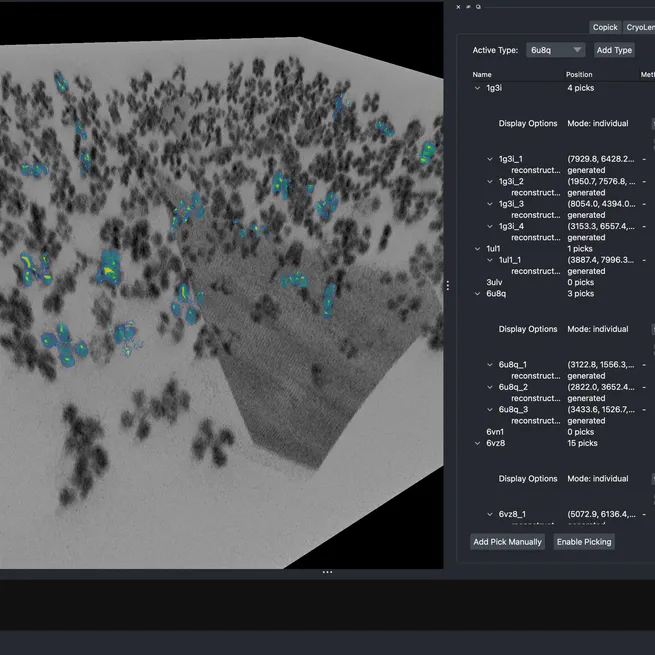
CryoLens is a pre-trained generative model for particle analysis in cryo-electron tomography. Given a single particle, it reconstructs the structure, embeds it, and estimates its pose. It is a variational autoencoder with a segmented Gaussian splat decoder. Rather than emitting a voxel grid, the decoder describes a particle as a set of 3D Gaussians and renders them into density, which is compared against the real subvolume. Rendering is differentiable, so the model trains end to end — and because density is represented continuously rather than per-voxel, reconstructions stay smooth at the resolutions where tomogram data is noisiest. It is trained on 5.8 million synthetic particles spanning 103 protein structures, so reconstruction is zero-shot: no per-dataset training is needed to get a structural estimate back, though fine-tuning on your own data helps. It is fast enough to give real-time feedback while picking particles. Install with pip install cryolens. The model is at czi-ai/cryolens (MIT), with a napari plugin for interactive picking, a REST server for pipelines, and a loader for copick projects. It is also published on the CZI Virtual Cell Platform, with an interactive demo.
Nov 5, 2025
Understanding Cellular Architecture with Interactive Machine Learning (invited)
Invited talk on interactive ML for cellular architecture analysis.
Jun 1, 2025
CZII CryoET Object Identification
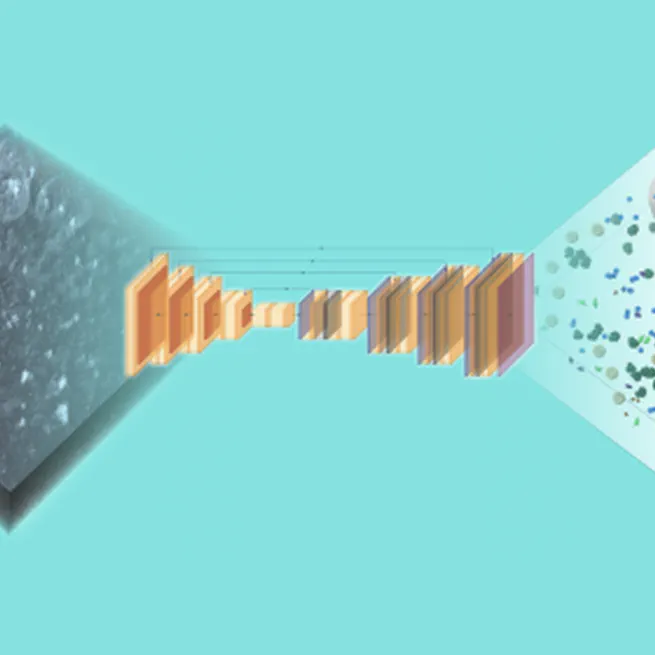
The CZII CryoET Object Identification Challenge, hosted on Kaggle from November 2024 to February 2025, was a machine learning competition focused on automating the detection of protein complexes in cryo-electron tomography (cryoET) data. Published in Nature Methods (Peck et al., 2025), this competition addressed a critical bottleneck in structural biology research by developing algorithms to accurately identify and annotate multiple types of protein complexes in 3D tomographic volumes. More on the Kaggle page
Nov 6, 2024
copick
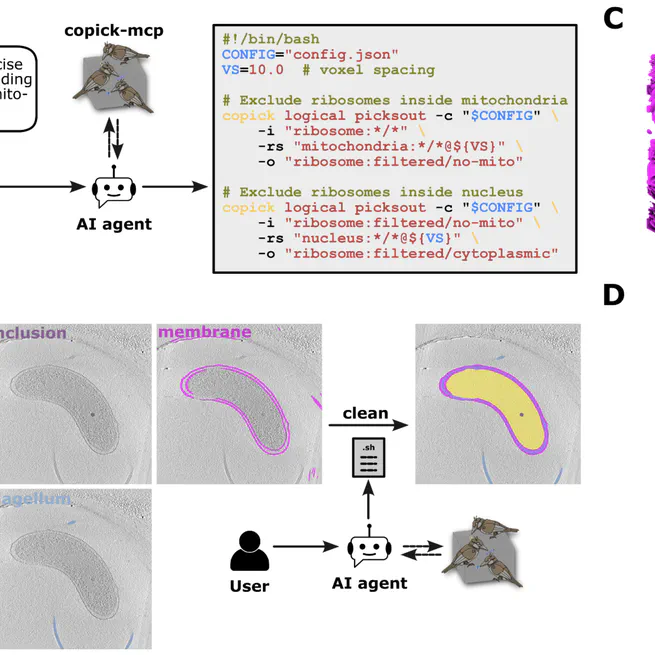
copick is a cross-platform API for collaborative work on cryo-electron tomography datasets. It provides standardized access to tomograms, picks, and segmentations across different storage backends—whether your data is local, on S3, or from the CZ CryoET Data Portal. Built to support the CZII CryoET ML competition on Kaggle, copick enables you to write data handling code once and have it work across diverse storage systems. This makes it easier to share annotations and build ML pipelines that scale across distributed data sources. Code: github.com/copick/copick
Jan 1, 2024