A generative AI framework for disease-specific lung microtissue bioengineering
Apr 16, 2026·,,,,,,,,,,,,·
0 min read
Ella Bahry
Jeanine C. Pestoni
Kai Hirzel
Taras Savchyn
Diana Porras-Gonzalez
Vera Getmanchuk-Zaporoshchenko
Martin Gregor
Thomas M. Conlon
Ali Önder Yildirim
Kyle Harrington
Deborah Schmidt
Gerald Burgstaller
Michael Heymann
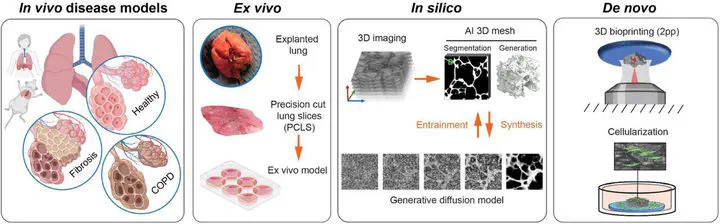 GLAM framework overview (Figure 1, Bahry et al., 2026, bioRxiv)
Abstract
Generative Lung Architecture Modeling (GLAM) is an integrated bioengineering framework that couples high-resolution three-dimensional tissue imaging with generative artificial intelligence to de novo design and 3D-bioprint anatomically detailed lung microtissue models. Native extracellular 3D matrix architectures of pulmonary parenchyma were extracted from healthy, fibrotic, and emphysematous in vivo mouse disease models and processed through a computational pipeline containing pre-trained image segmentation and 3D mesh generation. The resulting datasets were used to train a U-Net generative diffusion model with attention layers capable of synthesizing healthy and diseased lung tissue architectures. Microtissue cubes of about 200 - 300 µm edge length of native and synthetic datasets were fabricated through high-resolution two-photon stereolithography with gelatin-methacryloyl biomaterial ink and successfully seeded with cells, demonstrating biological compatibility. In closing the loop between biological imaging, generative modeling, and high-resolution biofabrication, this integrated framework establishes generative AI as a functional design layer for tissue engineering. The resulting lung microtissues retained architectural features of the native and original tissues, making them an application-ready platform for customizable and scalable fabrication of biological tissue surrogates for preclinical modeling, drug testing, and precision regenerative bioengineering.
Type
Publication
bioRxiv